.svg?w=300&h=85)
You pick up a silk sleepwear. Your fingers glide across the fabric. It feels soft, cool, weightless.
But have you ever wondered where that comfort actually comes from?
The cocoon itself? The weaving process? Or that little tag that says "100% Mulberry Silk"?
Here's the truth: "100% silk" only tells you what it's made of. It doesn't tell you how it was made. What really determines whether a silk product is safe enough to wear against your skin is whether someone has checked every step — from the mulberry tree to your wardrobe — and filtered out what shouldn't be there.
That's what certifications are for. They're not complicated. You just haven't had a chance to understand them yet. Below are four labels you've probably seen on tags — but may not know what each one actually checks for you.
At TOWNSSILK, we make silk products designed for skin contact. That's why OEKO-TEX is the certification we hold and build our safety claims on. Below, we explain what each certification checks — including GOTS, GRS, and OCS — so you can read any silk tag with confidence.
OEKO-TEX: Is This Silk Safe to Wear?
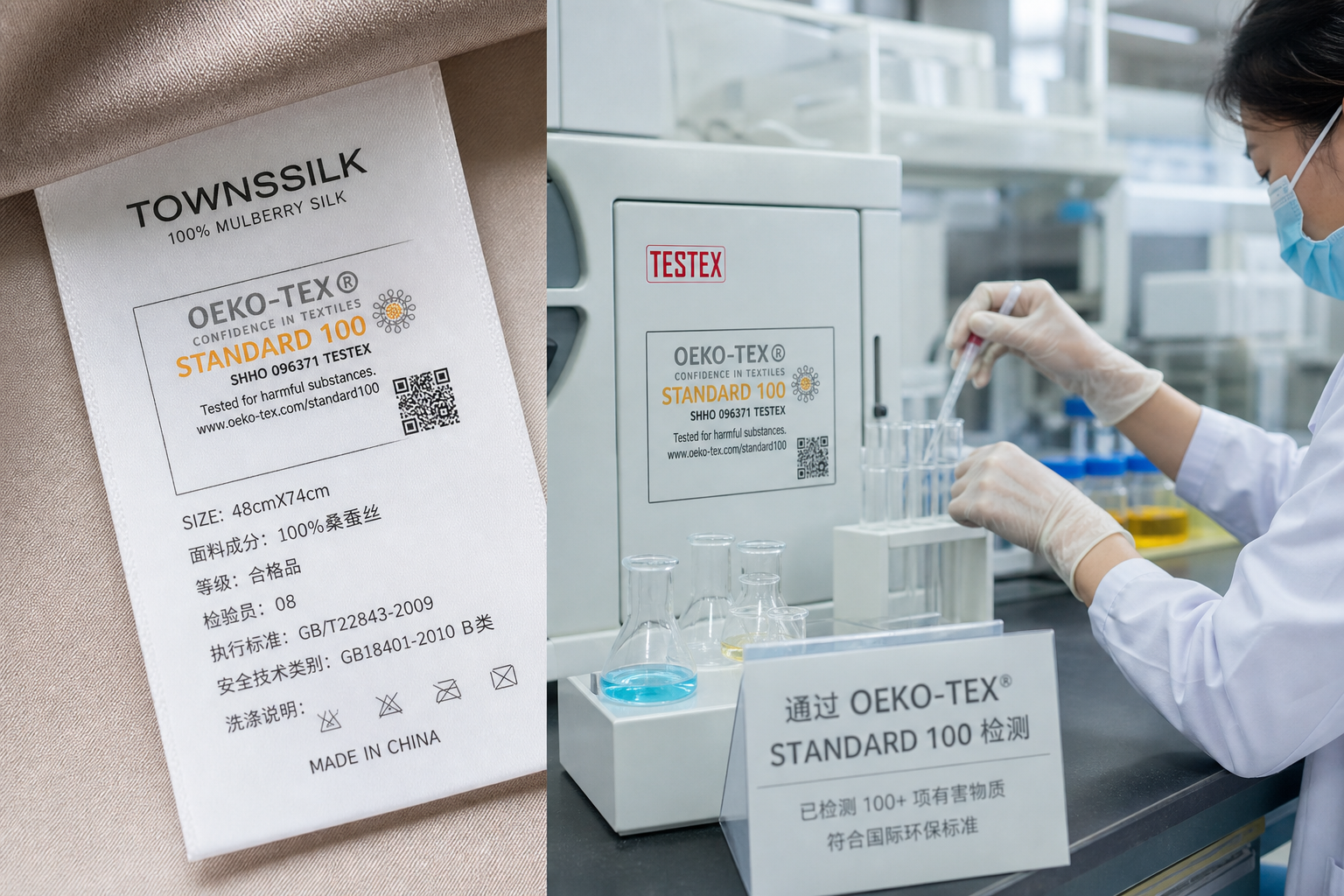
OEKO-TEX STANDARD 100 answers the question that matters most when silk touches your skin: Is there anything in the finished product that shouldn't be there?
It doesn't care how the mulberry trees were grown. It doesn't check worker conditions. It does one thing: takes the finished product into a lab and tests for more than 1,000 harmful substances — formaldehyde, heavy metals, carcinogenic dyes, PFAS, pesticide residues. Everything gets screened.
More importantly, it doesn't just test the fabric. Every component — the sewing thread, the buttons, the zipper — is tested too. Because those things also touch your skin.
OEKO-TEX also classifies products by use:
- Class I: For babies and children up to 36 months (most stringent)
- Class II: For products worn next to the skin, like silk sleepwear and bedding
- Class III: For products used away from the skin
- Class IV: For furnishing and decoration materials
For silk sleepwear, bedding, and anything you wear directly against your body, Class II is the standard that matters. It's the category specifically created for skin-contact products — and it's the one that tells you the finished product has been tested for the things you'd never want next to your skin.
At TOWNSSILK, our silk products hold OEKO-TEX certification at Class II — the skin-contact safety standard. This is the certification we rely on for the claim that our silk is safe to wear directly against your skin.
That means you can take it out of the package and wear it directly. You don't need to "wash it first." The cleanliness has already been tested for you.
For us, this isn't a marketing badge. It's the baseline we start from. Every piece of silk we sell has passed the same test we'd want for our own family.
The consumer takeaway: OEKO-TEX is the baseline for skin safety. It doesn't ask "is it organic?" It answers one question: Is it harmful? If a silk product touches your skin, this is the label to look for first.
GOTS: Was This Silk Grown in Good Soil?
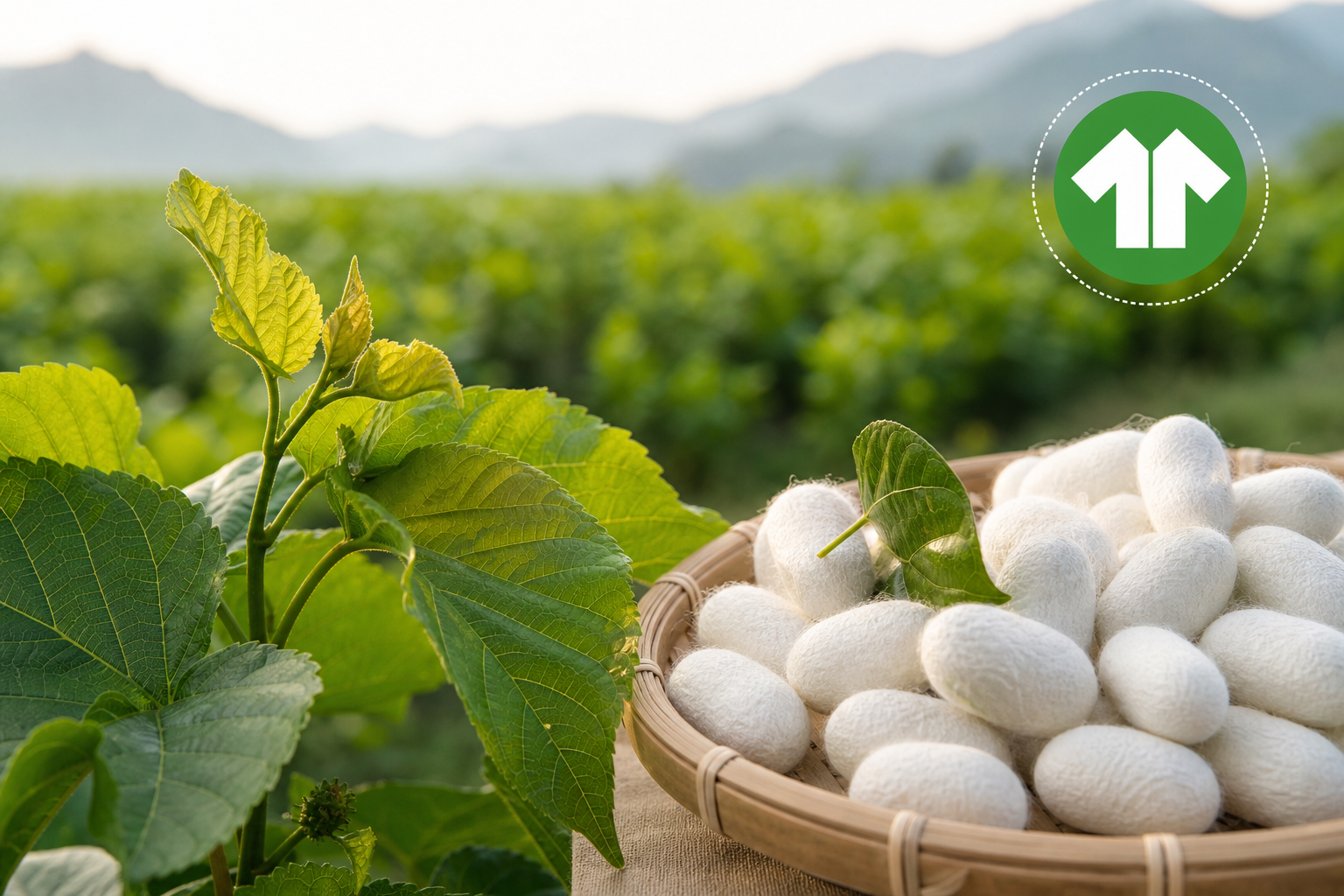
GOTS (Global Organic Textile Standard) answers the source question.
It verifies that the mulberry trees feeding the silkworms were grown without toxic pesticides, without chemical fertilizers, without GMOs. Clean leaves go in, clean silk comes out.
But that's just the beginning. GOTS requires that every stage along the chain — from mulberry farming, cocoon processing, weaving, and dyeing to the final product — is free from prohibited harmful chemicals. And the workers who made this silk? No forced labor, no child labor, safe working conditions.
GOTS is currently in its Version 8.0, released on 2 March 2026. It will become mandatory for all certified entities on 1 March 2027, following a one-year transition period.
GOTS has two grades:
- "Organic": ≥95% certified organic fibers
- "Made with Organic": ≥70% certified organic fibers
Anything below 70% cannot carry the GOTS label.
The consumer takeaway: If you're buying silk and want the strongest available assurance about organic sourcing and responsible processing, GOTS is the most direct "source assurance" you can find. But remember — GOTS covers the whole chain from soil to finished product. It doesn't test whether the finished product is immediately safe for your skin. That's a different label's job.
GRS: Is This Silk "Circular"?
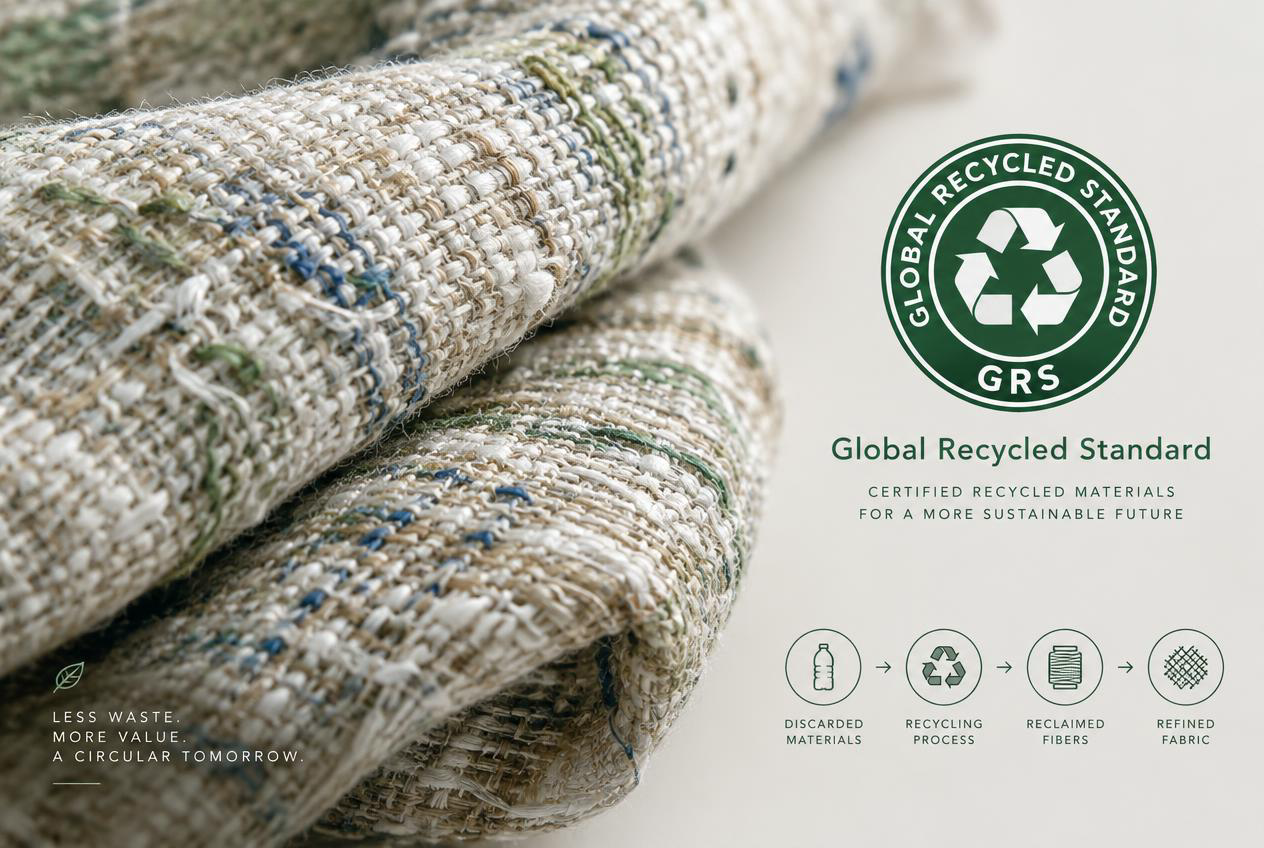
GRS (Global Recycled Standard) answers another question: How much of this product is made from recycled materials?
It requires at least 20% recycled content for the product to be certified. But to carry the GRS logo on a consumer-facing tag, the product must reach 50% or more. Below that, the product is still GRS-certified — but the logo can only appear on business-to-business documents.
But GRS isn't just about counting percentages — it also requires that chemical use, wastewater treatment, and worker rights meet standards during recycling and processing.
For silk, recycled silk (from old silk products or production waste) can be GRS-certified. If you want a silk piece that represents "less waste," look for the GRS label. TOWNSSILK currently focuses on 100% pure mulberry silk and does not use recycled materials — but understanding GRS helps you make informed choices across the market.
The consumer takeaway: GRS is for people who care about circular fashion. But note: only products with 50%+ recycled content can carry the GRS logo on the consumer-facing tag. Below that, the product is still certified, but the logo stays on B2B documents — so what you see on the tag might just be a brand's own "recycled" claim, not the GRS logo itself.
OCS: How Much of This Silk Is "Organic"?
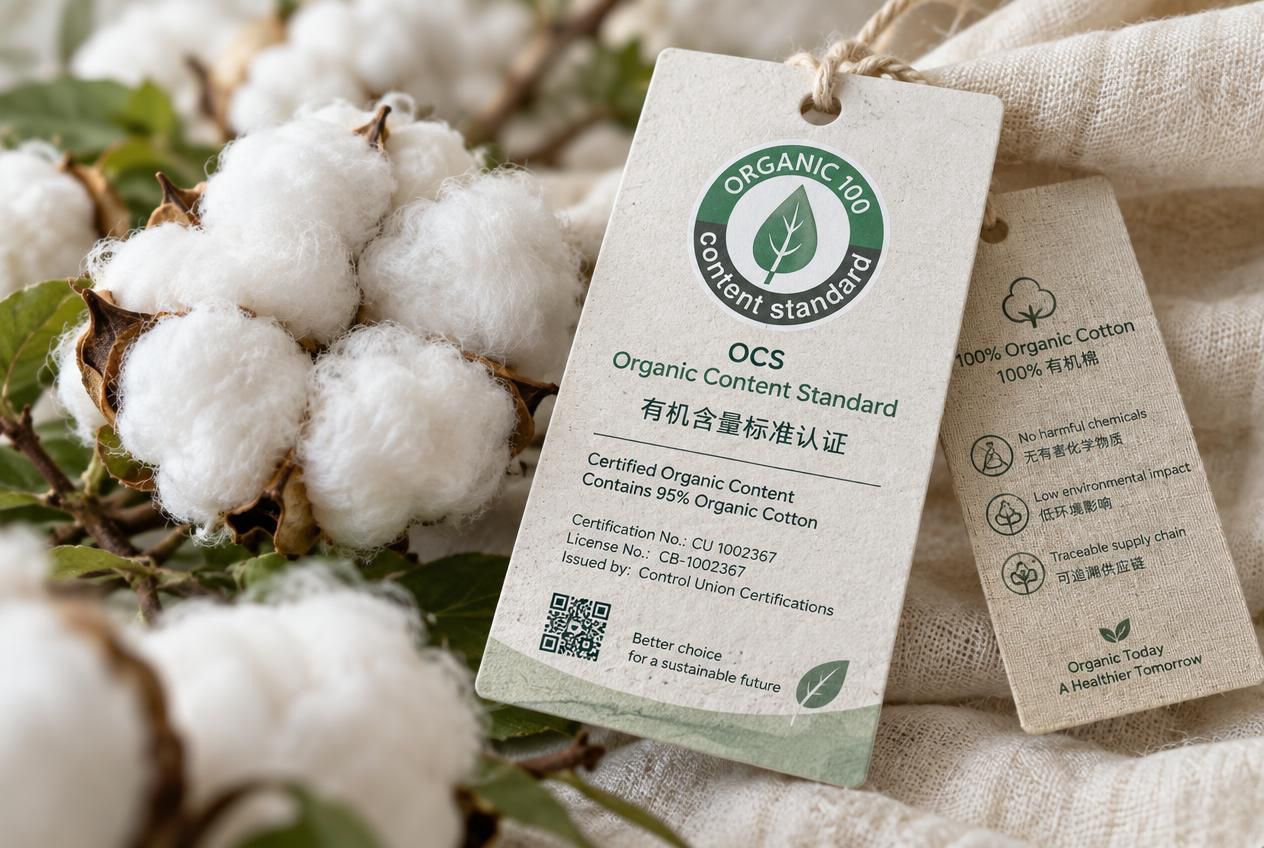
OCS (Organic Content Standard) answers the simplest question: How much organic material is in this product?
The threshold is also the lowest: 5% organic content is enough to apply. OCS has two label grades:
- OCS 100: ≥95% organic material
- OCS Blended: 5–95% organic material
But it only covers that one thing. OCS does not cover the certification of the raw material itself, does not address other inputs or accessories, does not manage environmental aspects of processing, and does not audit social or legal compliance issues. It only verifies that the organic content you claim is real and traceable.
In other words, OCS is a content label, not a safety label.
The consumer takeaway: If you see a silk product with only OCS and no OEKO-TEX or GOTS, it only proves "it contains some organic material." It does not prove the product is safe for you, and it does not prove it's environmentally friendly. TOWNSSILK relies on OEKO-TEX for its skin-safety claims — not OCS.
So, Which Label Should You Look For?
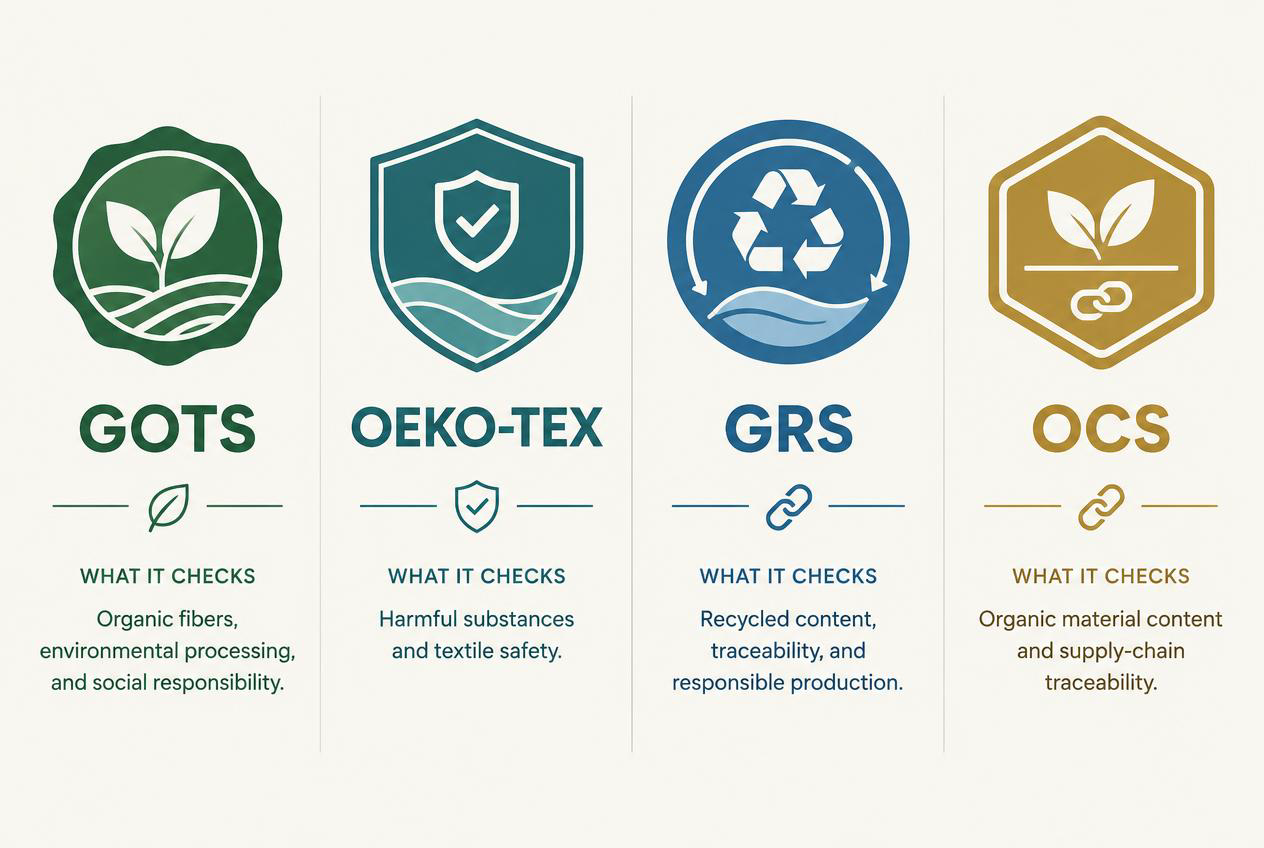
These four certifications are not substitutes for each other. They're complementary. Each answers a different question:
| The Question You Care About | The Label to Look For |
|---|---|
| Is it safe to wear against my skin? | OEKO-TEX |
| Was this silk grown in good soil? | GOTS |
| Is it made from recycled materials? | GRS |
| How much organic content does it have? | OCS |
If your priority is skin safety — and for sleepwear, bedding, and anything worn directly against the body, it should be — OEKO-TEX is the label to check first. It tests the finished product for over 1,000 harmful substances, including every component that touches your skin.
If you also want source assurance, you can look for GOTS alongside OEKO-TEX. If you want to know it's circular, look for GRS. If you want to verify organic content alone, look for OCS.
TOWNSSILK's silk products carry OEKO-TEX certification at Class II — the skin-contact standard. That's the certification we've chosen to build our safety promise on. It's the one that answers the question we care about most: Is this silk safe to wear against your skin?
Next time you buy silk, don't just look at "100% Mulberry Silk." Turn the tag over and see if someone has actually checked it for you.
FAQ
1. What is the most important certification for silk that touches the skin?
For skin contact, OEKO-TEX STANDARD 100 is the most direct safety certification. It tests the finished product for more than 1,000 harmful substances, including every component that touches your skin. TOWNSSILK holds OEKO-TEX certification at Class II, the standard for products worn next to the skin.
2. Does OEKO-TEX certification mean the silk is organic?
No. OEKO-TEX tests for harmful substances in the finished product. It does not require or verify organic fiber content. A silk product can be OEKO-TEX certified without containing any organic silk.
3. Can a silk product have both GOTS and OEKO-TEX certification?
Yes. Some premium silk brands hold both. GOTS confirms organic origin and responsible production; OEKO-TEX confirms the finished product's chemical safety. TOWNSSILK holds OEKO-TEX — the certification that directly addresses skin safety.
4. What does GRS certification mean for silk?
GRS applies to products containing recycled materials. For silk, it verifies that recycled silk content meets the minimum threshold (20% for B2B, 50% for consumer labels) and that recycling and processing meet environmental and social standards.
5. Is OCS enough to guarantee safe silk?
No. OCS only verifies organic content and traceability. It does not test for harmful chemicals, manage wastewater, or audit worker conditions. If you want safety assurance, look for OEKO-TEX. TOWNSSILK relies on OEKO-TEX certification for skin safety — we don't use OCS as a safety claim.
6. How can I verify a silk product's certification?
Look for the certification logo on the label or hangtag. Each certification has a license number or certificate number that can be verified through the official database (OEKO-TEX label check, GOTS public database, etc.).
Conclusion
Next time you're shopping for silk, don't stop at "100% Mulberry Silk." That label tells you what the product is made of — but not how it was made, what's in it, or whether it's safe against your skin.
Here's what each certification gives you:
- OEKO-TEX → assurance that the finished product is free from harmful chemicals — the most direct skin-safety check
- GOTS → assurance that the silk comes from organic sources and was responsibly processed
- GRS → assurance that recycled silk content is verified and responsibly processed
- OCS → verification of organic content, and nothing more
They're not competing standards. They're different tools for different concerns. But if you're buying silk to wear against your skin, OEKO-TEX is the one that answers the question that matters most: Is it safe?
TOWNSSILK holds OEKO-TEX certification at Class II — the skin-contact standard. It's the certification we've chosen to stand behind, because it checks what actually touches your skin.
So the next time you pick up a silk product, turn the tag over. See if someone has actually checked it for you.
At TOWNSSILK, we've already done that check — for every piece of silk we make. Not because it's a trend. Because you're going to wear it against your skin.
TOWNSSILK. Silk that's been checked — from cocoon to your skin.
.png?w=1536&h=1024)